How to use the Derila pillow: which way up, how to sleep on the Derila Ergo cervical neck pillow, and how to wash it

Updated: October 2026 · Tested for several weeks

On my first night with the Derila Ergo, I put it the wrong way round. High edge under my head, nothing under my neck, and a feeling of sleeping on a step. The next morning I looked at it side-on, read the brand's short guide again, and everything made sense. This is the guide I wish I'd had that night.
The 30-second version: the higher edge goes towards you, under your neck. Your head rests in the central hollow. Your shoulders stay on the mattress. Expect three or four nights to adjust. The cover goes in the washing machine; the foam never does. And if it really doesn't suit you, you have 60 days from delivery to return it (official site purchases only).
If you're still deciding whether to buy, my full Derila pillow review covers four weeks of nights, the Trustpilot figures and who it isn't for.
Know your Derila Ergo memory foam pillow before you lie on it
The Derila Ergo is an ergonomic pillow made of high-density polyurethane memory foam (CertiPUR-certified, according to the brand), with no latex. It's 54 x 36 cm, about 12 cm high and weighs about 1 kg. Unlike a standard rectangular bed pillow stuffed with polyester or feathers, it's a single piece of solid moulded foam with a fixed shape. You can't plump it like the rest of your bedding, so with a pre-shaped, contoured pillow like this you need to place it correctly.
Lay it flat on the bed and find these zones, as the brand describes them:
- The central core (the hollow). The lower middle section. Your head rests here on your back. It also gives a chin rest and leaves space for your ear.
- The front support wings. The raised edge on the neck side. This works like a contoured neck roll: it fills the gap under the natural curve of the neck.
- The back and side wings. These take your head when you turn onto your side, keeping it at the right height.
- The shoulder cut-outs and arm area. Room for your shoulder on your side, and for your arm if you sleep with a hand under the pillow.
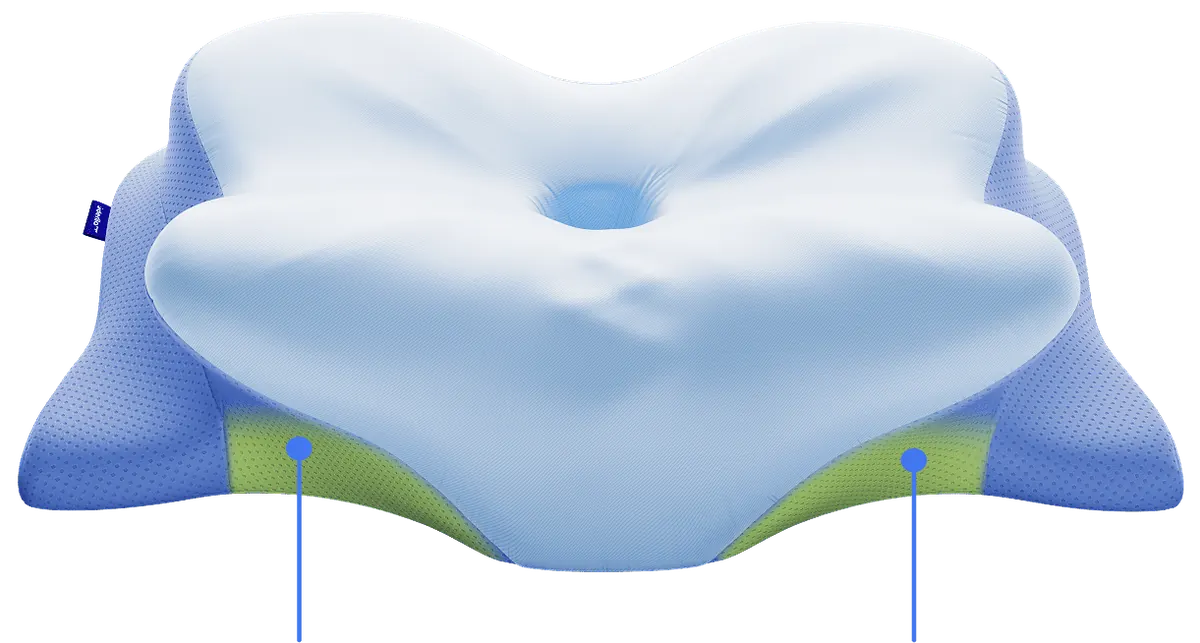
The brand's visuals are illustrative and not based on clinical comparisons.
Which way up does the Derila pillow go? Setting it up, step by step
This is the question people ask most, on Reddit and elsewhere. Here's how to place the pillow from night one.
- Unpack it and let it breathe. New foam needs a few hours to settle and may smell faintly at first. Leave it out of the cover in a well-ventilated room, ideally for a day. Mine smelt of nothing after a day by an open window.
- Look at it side-on. One edge is higher than the other. The higher edge, with the front wings, goes towards you, under your neck.
- Check it's the right way up and facing you. The brand's own guide stresses this before you lie down.
- Put it at the top of the mattress, centred. Your shoulders stay on the mattress, not on the pillow.
- Lie down, tuck your neck against the front curve, then let your head drop back into the hollow.
- Check your alignment. On your back, you should be looking at the ceiling, not towards your feet. On your side, your nose should line up with your breastbone.
A quick rule: if there's a gap under your neck, the pillow is too far from your shoulders or the wrong way round. If your chin is nearly on your chest, you've slid too far up.
How to sleep on it: side sleeper, back sleeper or stomach sleeper
The pillow's job is to support your head and neck and keep your spinal alignment, whatever position you sleep in. But where you put your head changes slightly with each one.
| Sleep position | Where your head goes | Zones used |
|---|---|---|
| Back | Neck against the front curve, back of the head in the central depression, shoulders on the mattress | Central core + front wings |
| Side | Side of the neck against the front curve, head on a wing, shoulder in the cut-out | Side wings + shoulder cut-out |
| Stomach | Slide a little higher, cheek in the central hollow, arm in the arm area | Central core + arm area |
| You move around | Keep the pillow facing you; your head rolls from the hollow to a wing | All zones |
Back sleepers
This is where the Derila felt most obvious to me. The front curve fills the hollow of the neck and the hollow cradles the head without pushing it forward, so the cervical spine stays in line with the rest of the spine and the upper back.

Side sleepers
Rest the side of your neck against the front curve, as the brand suggests. Your head lies on a wing, at a height that fills the space between ear and shoulder. Bring your lower shoulder slightly forward so it sits in the cut-out rather than being squashed. If your head drops below the wings of the pillow, your shoulder is probably too far up. Plenty of side sleepers also put a cushion between their knees, which helps overall sleep posture; it isn't essential, but it keeps the hips straighter.

Stomach sleepers
The brand says it works, if you slide up a little and turn your cheek into the hollow. Honestly, it's the weakest position. At about 12 cm high, the pillow keeps your head raised, which twists the neck. The NHS neck pain advice is not to sleep on your front at all. If that's the only way you can sleep, this probably isn't the pillow for you.
Restless sleepers
Most of us. Keep the pillow facing you and let it do the work: as you roll from back to side, your head moves from the hollow onto a wing. It took me two or three nights for that to feel natural.
The first nights: how people typically use the adjustment period
Don't judge it on night one. Your body is used to your old pillow, and memory foam this dense feels firm at first, a long way from a plush feather pillow.
For me it took three or four nights. The first night I woke feeling I'd slept on something harder than usual. By the fourth, I'd stopped thinking about the pillow and my morning stiffness had started to ease. That's my experience, not a promise. A few things helped:
- fall asleep in the same position for a few nights running;
- turn the pillow back round if you find it the wrong way at 3am;
- check your mattress isn't too soft: if you sink a lot, the pillow feels higher than it is.
Can the Derila pillow be washed? Cover, pillowcase and foam care
Washing the outer cover
Yes, the cover is removable and machine washable. Use a gentle, cool wash and always check the care label before the first wash. Let it dry fully in the air before you put it back: a damp cover on foam is a bad idea.
The foam: never in the machine
The memory foam core itself must never go in the washing machine or tumble dryer. Air it regularly without the cover, near an open window. For a small mark, dab it, don't rub, and let it dry completely before putting the cover back on.
The Derila cooling pillowcase: do you need it?
The standard cover already has a cooling-effect fabric (the brand talks about cooling technology). I found it pleasant from the first night, with no hot cheek. During the order, the site offers Derila pillowcases as an extra, and that pushiness is one of the most common complaints on Trustpilot. You don't need one to start.
Can you put a normal pillowcase on a Derila pillow?
Yes. A standard pillowcase, usually bigger, will be a bit loose around the butterfly shape, but it works. What matters is that it isn't tight: a pillowcase that squeezes the foam flattens the wings and changes the height.
Common mistakes with a cervical neck pillow
- Upside down or back to front. High edge under the head instead of the neck: it feels too high and too hard.
- Shoulders on the pillow. They belong on the mattress, or your head gets pushed forward.
- Giving up after one night. The adjustment period is real.
- Using it as a memory foam travel pillow. At about 1 kg it fits in a suitcase, but it's a bed pillow, not a U-shaped cushion for the plane.
- Expecting it to treat a medical problem. It's a comfort pillow. If neck pain lasts for weeks or comes with other symptoms, see your GP. If you're here because of snoring, read the Derila pillow and sleep apnea first.
If it still doesn't suit you
Some people never get on with it, often front sleepers or people who love a soft pillow. If you bought it on the official site, you have 60 days from delivery to return it, even if you've just changed your mind. Use the contact form to get a return number (RMA); the refund arrives within 14 working days of them receiving it. Postage isn't refunded. Bought from another seller? Their policy applies.
For everything else, including how it held up over four weeks and what 46,037 Trustpilot reviewers say, read my Derila Ergo pillow review. Packs and prices are on the Derila pillow price page.
Try the Derila Ergo with 60 days to decideOfficial Derila site · 60-day returnsHas written about health and sleep for 9 years and tests pillows, mattresses and sleep accessories for readers who wake up with a stiff neck. She judges a pillow on what matters at night: neck support, height, heat, the adjustment period and the returns terms. How we test
How to use the Derila pillow: FAQ
Which side of a contour pillow do you sleep on?
On the Derila Ergo, the higher edge with the front wings goes towards you, under your neck, and your head rests in the lower central hollow. If you feel a gap under your neck, turn it round.
What is the correct way to use a pillow?
A pillow should support your neck, not just your head, so that your head stays in line with your spine. Your shoulders stay on the mattress. The NHS neck pain advice also says to keep your head at the same height as the rest of your body.
Can you put a pillowcase on a Derila pillow?
Yes. A normal pillowcase works if it isn't tight; a tight one squashes the wings. Derila also sells shaped pillowcases, but they're optional.
How do I use my pillow for the first time?
Take it out of the packaging and let it air without the cover for several hours in a ventilated room. Place it the right way up, higher edge towards you, and give yourself three or four nights to adjust.
Can the Derila pillow be washed?
The cover can: it's removable and machine washable on a gentle, cool cycle (check the label). The foam can't go in the machine; air it and spot-clean it instead.
Is the Derila pillow good for side sleepers?
Yes, it's one of its best positions: your head rests on a wing at a height that fills the space between ear and shoulder, and your shoulder sits in the cut-out.